
What we install
Four systems cover the water problems this part of Louisiana has, north or south of the lake. Your neighborhood's report decides which ones your home needs, and your exact price comes in writing before any work.
1. Water arrives with the disinfectant still in itChlorine or chloramine from the utility, plus the dissolved minerals behind film and flat taste.
2. The carbon tank catches the chlorineEvery tap, shower, and appliance in the house gets water without the pool taste and smell.
3. RO finishes the drinking waterDissolved minerals come out at the kitchen sink, so glasses rinse clean and the water has no aftertaste.
Which system fixes which problem?
| Your symptom | Carbon | RO | Softener | Well system |
|---|---|---|---|---|
| Pool taste and smell | ✓ | ✓ at the sink | · | · |
| Dry skin and dull hair | ✓ | · | · | · |
| Spots on glasses rinsed at the sink | · | ✓ | · | · |
| Flat coffee | · | ✓ | · | · |
| Crusty scale from hard water | · | · | ✓ | · |
| Rotten-egg smell | · | · | · | ✓ |
| Orange stains in tubs and laundry | · | · | · | ✓ |
| Bacteria worry on a well | · | · | · | ✓ with UV |
| Drinking water you trust | · | ✓ | · | · |
Details on every system below, with the actual units.
Whole-home carbon filtration
Removes: the chlorine and chloramine in every tap and showerTakes the chlorine or chloramine out where water enters your house, so every tap, shower, and appliance gets clean water. A full-size tank gives the water real contact time with the media, which is what cartridge gadgets from the big-box store can't do.
The spec that matters here: Covington, Mandeville, and Slidell use chloramine, which ordinary carbon barely touches. Those towns get catalytic carbon, and your neighborhood's report tells us which your town needs before we ever quote you.
Reverse osmosis drinking water
Fixes: drinking water taste, film on glasses, flat coffeeSilica, sodium, and dissolved minerals are the things carbon and softeners cannot remove. RO can. Four stages under the kitchen sink strip out the dissolved solids and feed a dedicated faucet at the kitchen sink.
Glasses you rinse at this sink dry spotless, coffee stops tasting flat, and you stop paying for bottled water. For older homes, this is also the certified answer for lead, which usually enters through a house's own aging pipes.
This system serves the kitchen tap. Your dishwasher and showers run on separate plumbing, so they stay covered by the whole-home carbon system.
Water softener
When your water runs hard, and only thenSofteners fix genuinely hard water: crusty scale, stiff laundry, soap that won't lather, and scale eating the water heater. When your water runs hard, a softener belongs in the system.
When it doesn't run hard, a softener stays out of the quote. The numbers in your neighborhood's report make that call, and we'll show you the number either way.
Well water systems
Fixes: rotten-egg smell, orange staining, sedimentSulfur gas that makes the bathroom smell like rotten eggs, iron that stains tubs and laundry orange, sediment, and acidic water eating copper pipe. Wells have no public report, so your system is built from a tap test.
Air-injection oxidation handles iron and sulfur with no chemicals to buy and no feed pumps to maintain. A neutralizer joins if your water runs acidic, softening if it runs hard, UV if bacteria is a concern.
The upgrades worth talking about
Options for specific situations: wells, big households, and homeowners who want the upgraded version. Your report or tap test says whether any of them apply to you. These are the real units.
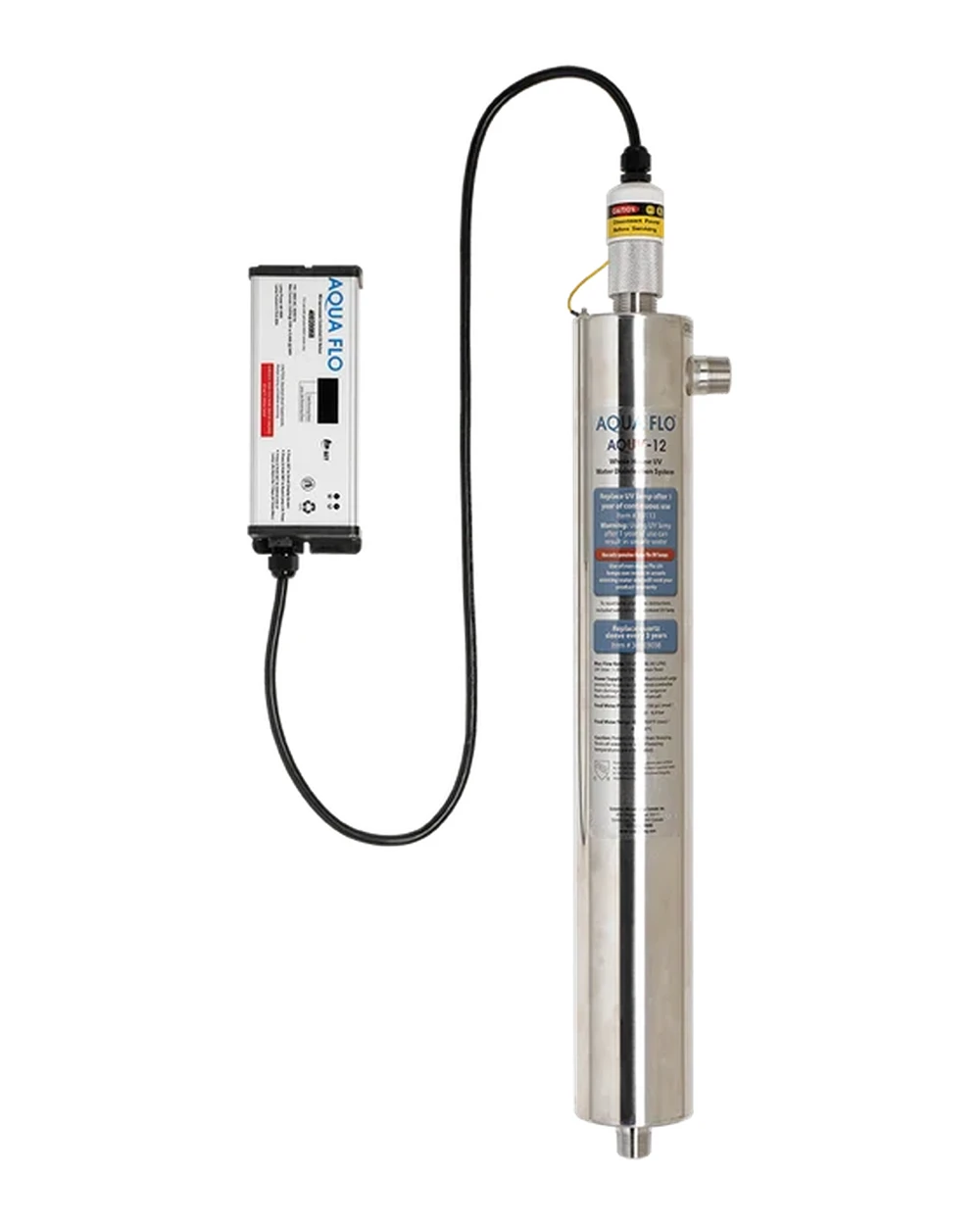
Whole-house UV disinfection
A stainless UV chamber neutralizes bacteria, viruses, and cysts in the water path, with no chemicals added. Standard equipment on wells, and a belt-and-suspenders addition some city homes want.
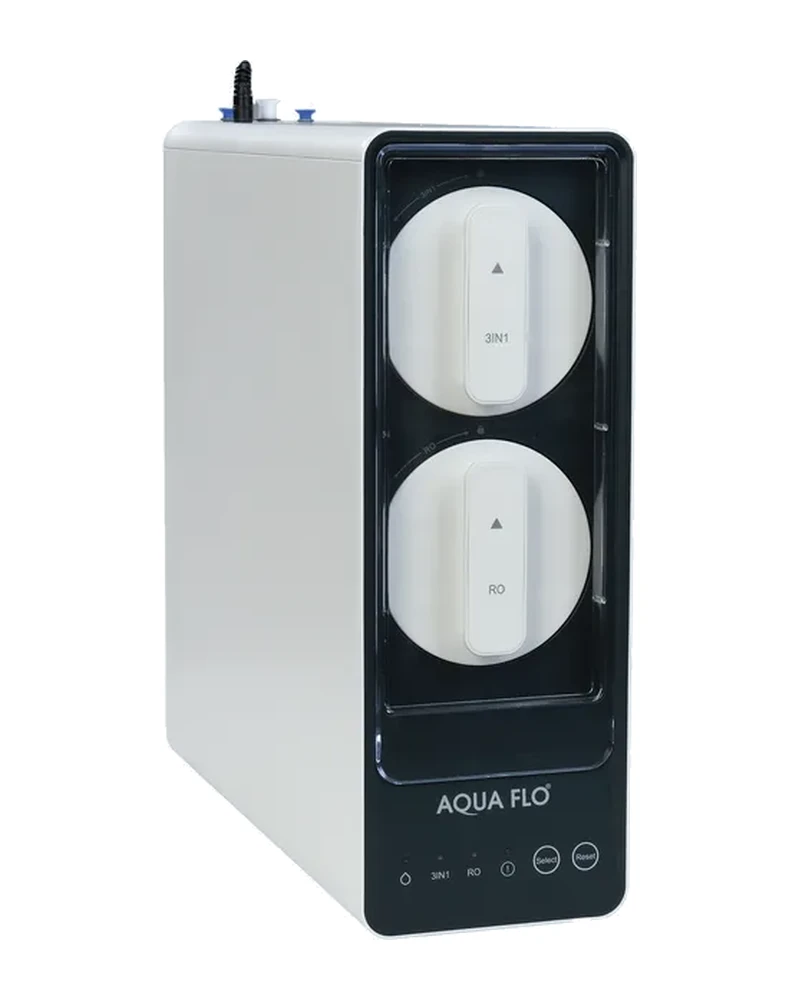
High-efficiency tankless RO
Makes drinking water on demand with no storage tank, so it takes up far less room under the kitchen sink, and its twin quick-change cartridges swap in seconds. The souped-up choice for a busy kitchen.
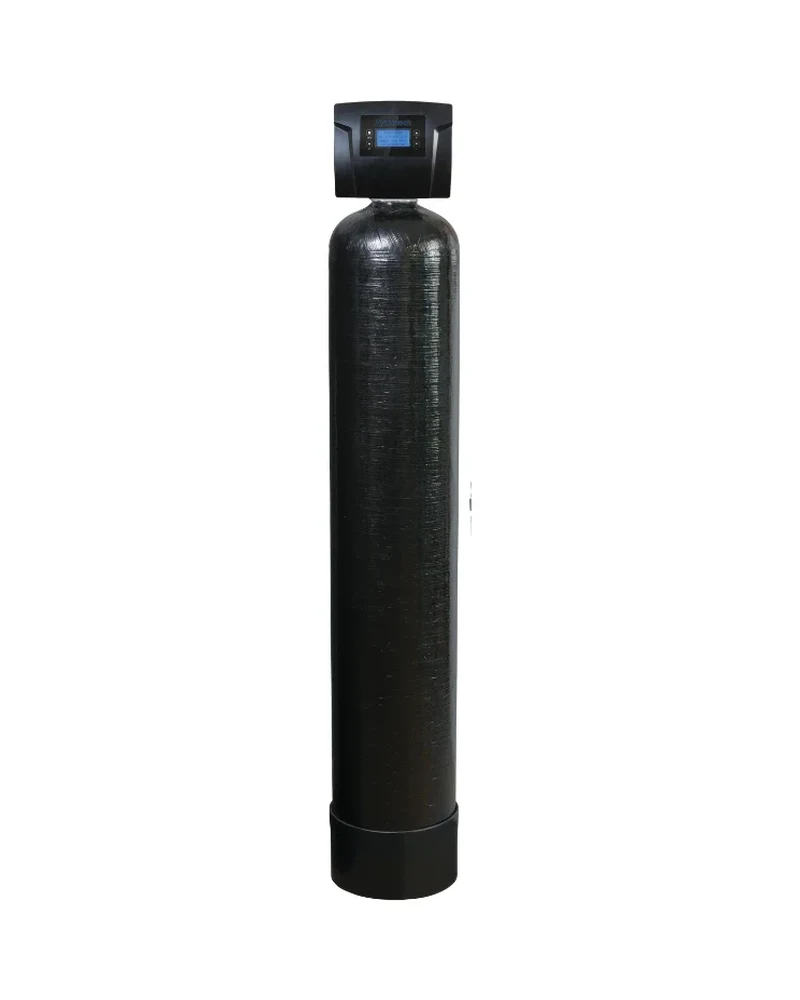
The XL platform
The same whole-home system with a bigger tank, more media, and full-port flow, sized for three-plus bathrooms so the last shower of the morning gets the same water as the first.
How each system actually works
The short version is above. These are the full explanations, in plain English, for the readers in the family.
The whole-home carbon filter, explained
What is in the tank. Activated carbon: charcoal cooked until it is riddled with microscopic tunnels. A handful of it hides more surface area than a football field, and that surface is the whole trick. As water moves through the tank, chlorine sticks to it and stays behind. Engineers call it adsorption.
Why the tank is big. Contact time decides how much comes out. Water has to spend real seconds against the carbon, so we install a full-size media tank with a one-inch path through it. Your shower pressure stays where it was, and the water gets the time it needs.
The chloramine wrinkle. Some towns disinfect with chloramine, which is chlorine bonded to ammonia, and that bond is stubborn. Those towns get catalytic carbon, a version processed to break the bond apart before the carbon grabs on. Your neighborhood's report tells us which one your house needs.
Living with it. At night the valve runs a backwash: it reverses the flow, fluffs the media bed, and rinses what it has collected to the drain. There are no cartridges to remember. The first thing families notice is the shower, because the pool smell is gone. Coffee, tea, and ice follow, and the rubber seals and hoses in your appliances stop soaking in disinfectant all day.
The water softener, explained
What hard water is. Rock your water dissolved on its way to you, mostly calcium and magnesium. It is fine to drink and hard on everything else: it bakes onto heater elements as scale, stiffens laundry, and fights your soap.
How the trade works. Inside the resin tank are millions of tiny beads holding a light sodium charge. Water threads between them, the beads swap their sodium for the calcium and magnesium, and the water leaves soft. Chemists call it ion exchange, and softeners have run on it for a century.
Where the salt comes in. When the beads fill up, the valve draws salty water from the brine tank through the resin, knocks the hardness loose, and sends it down the drain. Ours meters your actual use and recharges only when capacity is spent, which keeps the salt bill low.
Why yours might not need one. On soft water the beads have nothing to grab. You would be buying salt and changing nothing you can feel. That is why a softener enters our quote only when your neighborhood's hardness number says it should.
Reverse osmosis, explained
The membrane is the heart. A sheet rolled into a cylinder, with pores close to the size of a water molecule. Pressure pushes water through, and the dissolved things that cannot fit, the silica, the sodium, the minerals, rinse away to the drain. Desalination plants use the same process to turn seawater fresh. This is that, scaled to a kitchen.
The other stages protect it. A sediment filter catches grit first. A carbon block takes out the chlorine that would eat the membrane. After the membrane, one last carbon polish sits right before your glass.
Why it serves one faucet. Drinking, cooking, and coffee flow through only a couple of gallons of a family's day. Making just those gallons to drinking-water grade is what keeps the system compact, quiet, and down to an annual cartridge swap you do by hand.
Tank or tankless. The standard unit stores a few gallons in a small pressurized tank so the faucet pours fast. The tankless version makes water on demand, takes up far less room under the sink, and swaps its twin cartridges in seconds. Same water in the glass either way.
UV disinfection, explained
Light as the disinfectant. The chamber is a stainless sleeve with an ultraviolet lamp down its center, tuned to a germicidal wavelength. Any microorganism passing through takes a dose of light that scrambles its ability to reproduce. Nothing is added to the water, and nothing about the taste changes.
Who needs it. On a well it is standard equipment, because a well has no city disinfection ahead of it. On city water it is optional insurance, and some families here add it for the boil-advisory weeks after a storm.
Living with it. One lamp a year, changed like a light bulb, plus a sediment prefilter that keeps the sleeve clear so the light always reaches the water.
How we size a system to your house
Start with bathrooms. Sizing starts with how much water the house can ask for at once. Two showers running while the washer fills is a very different demand than one person at a sink, and bathroom count predicts that far better than square footage.
Why the tank size matters. Carbon needs contact time. A tank that is too small for the house lets water rush through faster than the media can work, and the taste you paid to remove starts slipping past at exactly the busy moments. Too big wastes media and backwash water. The right size holds the water long enough at your peak demand.
Pressure is a plumbing question. The valve and porting are matched to your service line so the system does not become a bottleneck. That is why the units we install run full one-inch paths, and why we look at your plumbing before the quote instead of after the install.
What decides it. Three things: your bathroom count, your service line, and your neighborhood's report. Those pick the valve and the tank, and the quote names the exact model so you can look it up.
Well water systems, explained
Start from the test. A well is your own private water system, and it publishes no annual report. So the plan starts at your tap, with a test we run in front of you: iron, sulfur, hardness, pH, and bacteria. The system is designed from those numbers.
The workhorse tank. The air-injection unit holds a pocket of compressed air at the top. Incoming water sprays through it, and the oxygen turns dissolved iron and sulfur into solid particles, the same way a cut apple browns in open air. The media bed below catches the particles, and the nightly backwash sends them to the drain. Nothing gets bought, dosed, or refilled.
The rest joins as needed. A neutralizer when the pH runs acidic enough to work on copper pipe. A softener when the well runs hard. UV ahead of the house for bacteria. Two wells a mile apart can need entirely different systems, which is why the quote always waits for the test.
What each system changes
And what none of them change.
Whole-home carbon changes
- The pool taste and smell are gone from every tap and shower.
- Your appliances stop soaking in disinfectant, which is what wears out rubber seals and hoses.
- Coffee, tea, and ice clear up too, because the fridge line runs through it.
Reverse osmosis changes
- It feeds its own faucet at the kitchen sink.
- That's where your drinking water, cooking water, and coffee come from.
- Glasses you rinse there stop drying with film.
A softener changes
- Scale stops building on heater elements and fixtures.
- Soap lathers and rinses the way it should.
- Laundry comes out softer.
What no system on this page changes
- Etched glass stays etched. That damage is in the glass itself, and it is permanent.
- Stains that have already set into tubs or laundry stay put. Filtration stops new ones from forming.
- The buildup already inside your pipes stays where it is. The water just stops adding to it.
- No system reaches fixtures on plumbing it does not touch. The RO serves the one tap it is plumbed to.
- A filter does not cancel a boil advisory. When the parish issues one, follow it.
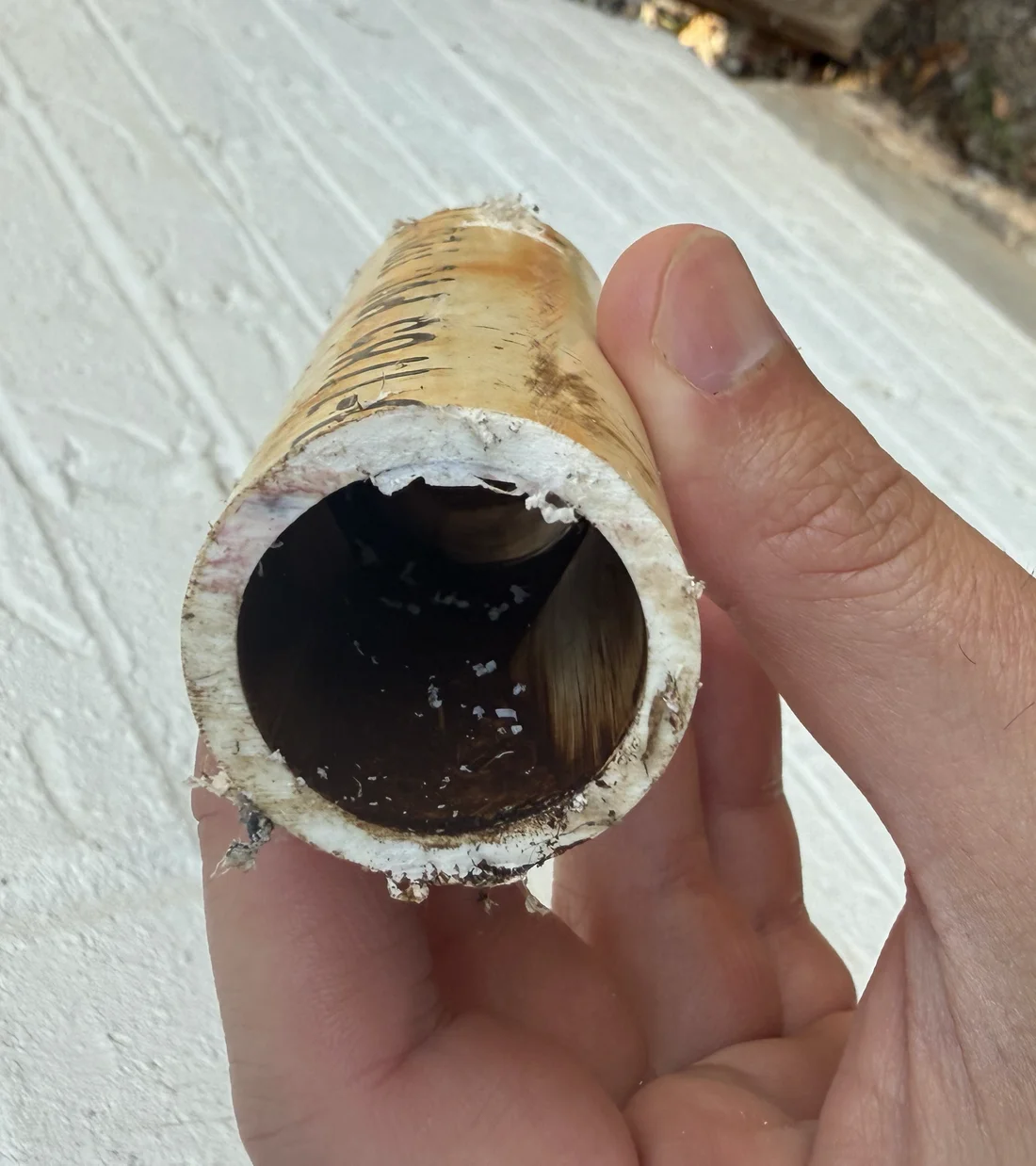
Building or buying new?
The best time to install is before the first glass of waterThe pipe in this photo came out of the founder's own Covington home. Years of mineral buildup, from water that tests soft. Every year it keeps coating the pipes, the water heater, and every appliance that touches water.
A new build skips all of it. The system goes in clean during construction, the plumbing stays the way it was on day one, and your appliances run on filtered water from the first glass. If you're building or buying new anywhere in Southeast Louisiana, this is the easiest install we do.
Get my written plan and priceAlready own a system?
Service, repair, and media replacementWe service and repair existing systems: worn media, tired resin, failed valves. Repairs get the same written, itemized quote as installs.
See what owning a system is like →
Get my written plan and priceWith every install
- We go over your neighborhood's report with you before recommending anything
- Your exact price is in writing before we start, and nothing gets added without your approval
- A licensed plumber does the work
- We walk you through your new system before we leave, then follow up to make sure everything's working the way it should
*Design preview. Certification statements and warranty terms reflect the equipment line under evaluation and will be finalized to the exact certified models before launch, with each badge linked to its official listing.